Yurii Zhivago's death
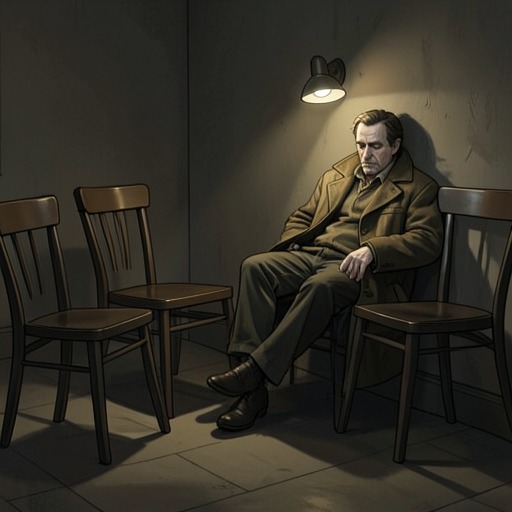
Doctor ZhivagoYurii Zhivago's death is a sudden, public ending to a life shaped by private attachments and historical upheaval. On a late-August morning, he takes a troubled trolley toward his first day of work at the Botkin Hospital; during its repeated delays, he becomes acutely ill, struggles to get out, and collapses in the street. The crowd gathers, but the scene does not become a vigil: Mademoiselle Fleury, passing through on her way to collect an exit visa, continues on, unaware that Zhivago has died and that she has survived him.
The journey to work
At the end of August, Zhivago boards a trolley at a corner of Gazetny Street for the journey up Nikita Street to the Kudrinskaia terminal. He is going to work at the Botkin Hospital, then known as the Soldatenko Hospital. Although he has visited the hospital once or twice for work-related reasons, this is his first day going there to take up his job.
The journey is repeatedly interrupted. The trolley has a defective motor: its progress is blocked when a cart's wheels catch in the rail grooves, and faults in the insulation cause the current to short-circuit. Each time it stops, the driver gets off with a wrench and crouches beside the machinery between the rear platform and the wheels. These mechanical delays furnish the immediate setting for Zhivago's final crisis, turning a routine trip into a sequence of stops from which the passengers cannot simply proceed.
Illness and collapse
During one of the trolley's halts, Zhivago feels an attack of nausea and tries to open a window. He pulls at the straps, but the window will not move. The other passengers tell him it is fastened with screws; in his panic and physical distress, he does not register either their words or what they mean. He tugs again, and a sudden, severe pain makes him understand that something has gone irreparably wrong.
The trolley moves a short distance down Presnia, then stops once more. Zhivago summons his strength to push through the crowded passage toward the rear platform. People obstruct him and snap at him as he passes. Once outside, the fresh air seems for a moment to help, and he wonders whether he may be recovering. He continues through the crowd and steps down from the trolley into the street. After three steps he falls on the stone paving and does not rise again.
A death in public
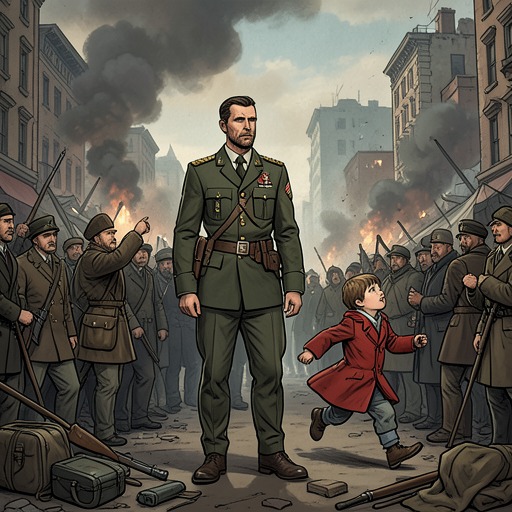
The passengers and people from the sidewalk gather around Zhivago. Their talk turns to what should be done: some propose putting him back on the trolley and taking him to the hospital, while others want the police called. The crowd soon discovers that he is not breathing and that his heart has stopped. His death is thus established amid ordinary public confusion, rather than in the hospital toward which he had been traveling.
The reactions around the body are mixed. Some onlookers are relieved that he was not run over; others are disappointed that his death has no connection to the trolley. Their attention makes the scene public, but does not restore intimacy or give the dying man a known place in the lives of those watching. They encounter a stranger whose death briefly interrupts their journey, then becomes a matter of competing suggestions about what to do next.
Mademoiselle Fleury and the final irony
A woman in lilac also approaches, watches for a moment, and listens to the discussion. She is Mademoiselle Fleury, a Swiss national who had been in Meliuzeievo and is now very old. After twelve years of petitioning the authorities in Moscow for permission to return to her native country, she has finally received approval. She is in Moscow to obtain her exit visa and is walking to her embassy with her documents bundled and tied with a ribbon.
Fleury understands enough to recognize the disagreement over whether Zhivago should be taken to a hospital or the police called, but she does not wait to learn what happens. She walks on, overtaking the stalled trolley for the tenth time. The narration draws out the contrast between the two travelers: Fleury's long-awaited departure continues, while Zhivago's journey ends beside the vehicle. She is unaware that she has overtaken and survived him, making her unknowing passage the scene's final measure of how one life can end within the passing movement of another.
Narrative significance
The death is presented through the physical and social details of a commute: a malfunctioning trolley, a window that will not open, a packed platform, a crowd unsure whom to summon. The circumstances do not turn Zhivago's final moments into a heroic act or a private farewell. Instead, the distance between his inward recognition of a fatal crisis and the passengers' practical, belated response gives the scene its starkness.
Fleury's presence expands that ending beyond the immediate crowd. Her own history of waiting for permission to leave Russia reaches its conclusion at the same moment that Zhivago's life does, though she does not know what has occurred beside her. The trolley's repeated stops and Fleury's repeated overtaking of it give the passage a quiet pattern of delay and passage. Zhivago's death is final, but the surrounding city continues to move, and the woman who passes him carries on toward the return she has waited twelve years to make.